


Just two weeks after the release of Gemini 4 Argon, Google unveiled Gemini 4 Carbon, its latest frontier artificial intelligence model. Positioned as the company’s strongest system yet, Carbon places a heavy emphasis on cybersecurity defense, autonomous coding, and long-term agentic tasks.
A New Leader on Independent Benchmarks
Gemini 4 Carbon has taken the top spot on the updated Artificial Analysis Intelligence Index v5.0, scoring 59 points. It surpasses Claude Opus 5.5 (58), GPT-6 Astra (57), and its predecessor, Gemini 4 Argon (50).
The model’s performance is driven by its leading results in complex reasoning, scientific knowledge, and tasks requiring sustained attention over extended periods. Carbon ranks first in four of the nine index evaluations, including HLE-Diamond, Terminal-Bench-Science, AA-Omniscience, and AutomationBench-AA.
While Carbon shows substantial gains in coding and knowledge work relative to earlier Gemini models, it does not lead in every category. On the Artificial Analysis Coding Agent Index, Carbon ranks second behind Claude Opus 5.5 with 59 points versus 62.
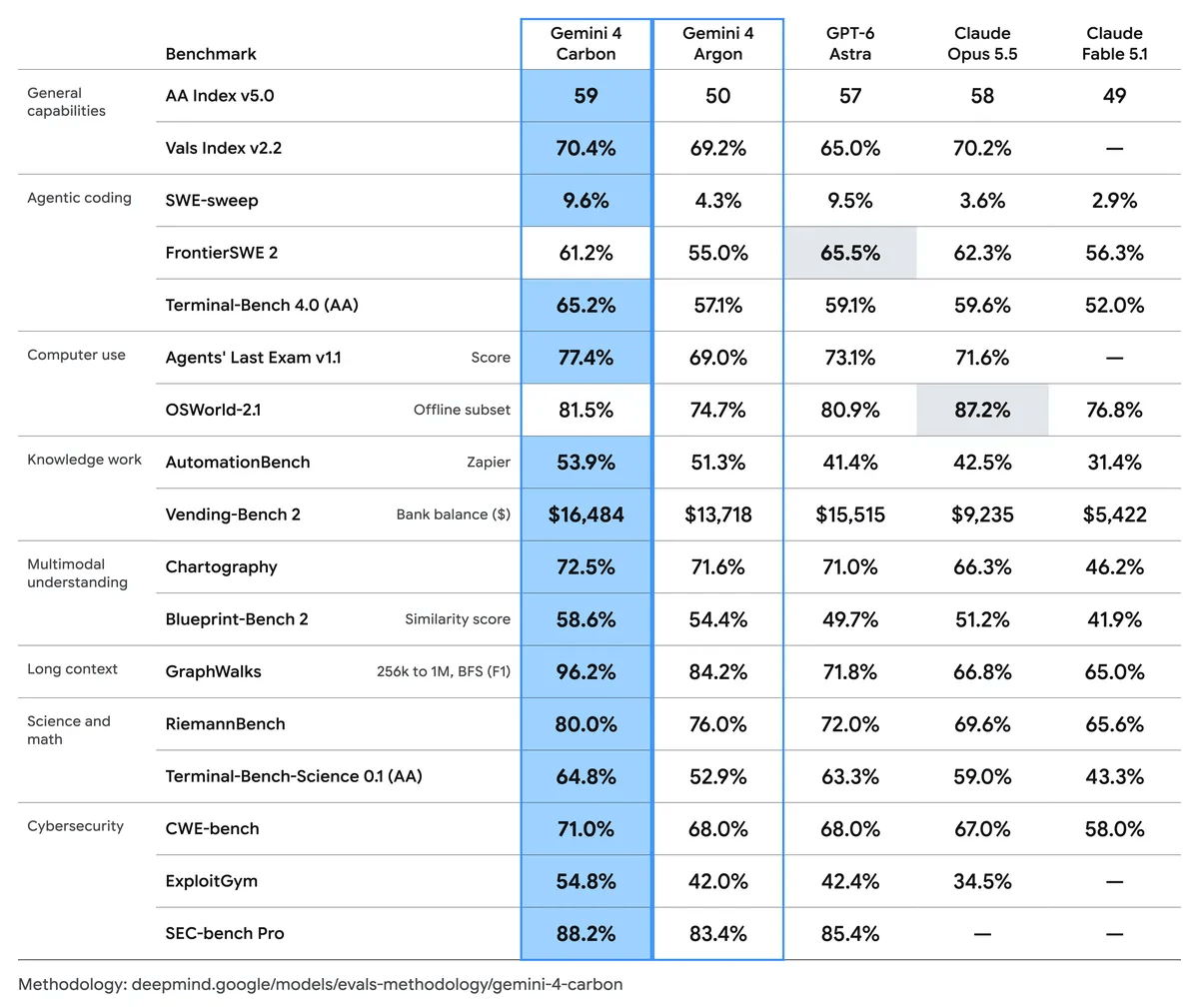
This represents a notable improvement for Google, which has historically underperformed in agentic coding evaluations. On WebDev Arena, Carbon climbed 89 Elo points to reach fourth place with a score of 1769, reflecting higher quality output in full-stack web development.
Cybersecurity as the Core Focus
The most striking differentiator for Gemini 4 Carbon is its cybersecurity capability. Google describes the model as delivering a “significant leap” across the vulnerability lifecycle: detection, validation, exploitation, and remediation.
On SEC-bench Pro, Carbon scored 88.2% on vulnerability discovery. It scored 54.8% on ExploitGym for exploitation tasks and 71.0% on CWE-bench for patching. Internal testing reportedly shows a more than twofold increase in the success rate of generating secure code compared to Argon. The Chrome team reported that Carbon generated high-quality security patches that were more than ten times better than those of another lab’s large frontier model.
However, these gains come with a cautious rollout. Initially, Google is making Carbon available only to a select group of cybersecurity defenders through its Fairwind Program. The company plans to make it available to developers, businesses, and consumers “as soon as possible” after receiving further feedback and refining the guardrails.
Given the model’s offensive and defensive security potential, the company is participating in the U.S. government’s voluntary pre-release testing framework, reflecting a deliberative approach.
Safety, Alignment, and Hallucination Trade-offs
Google claims that, compared to Argon, Carbon reduces unsupported claims by approximately half, stating methodological caveats directly rather than fabricating missing evidence. In multi-step workflows, the model reduces task overreach by 26% and under-service by 29%.
In the Grey Swan prompt injection evaluation, Carbon resisted every attempted attack, achieving a 0% vulnerability rate – better than Argon (0.7%), Claude Opus 5.5 (1%), and GPT-6 Astra (8.5%).
However, independent testing reveals a more nuanced picture. While Carbon’s accuracy on factual-knowledge benchmarks improved by 10 points over Argon, reaching 58%, its hallucination rate increased from 4% to 11%. This remains the second-lowest rate among frontier models, surpassing only Argon. However, it suggests that enhancing raw capability can introduce new trade-offs in reliability.
Technical Specifications and Pricing
Gemini 4 Carbon supports a one-million-token context window and accepts text, image, video, and speech inputs to produce text output. It is designed for sustained agentic workflows. Google reports that internal teams have run Carbon for days, persisting through dead ends to identify and resolve subtle bugs in large codebases and low-level systems.
Pricing follows the same introductory structure as Argon: $2 per million input tokens and $10 per million output tokens, with cached input tokens discounted by 95%. These rates are temporary. Standard pricing will increase to $4 per million input tokens and $20 per million output tokens. Google has not specified when the introductory period will end.